
The First Rugby World Cup Was League's, in 1954 — and Australia Owns Most of the Ones Since
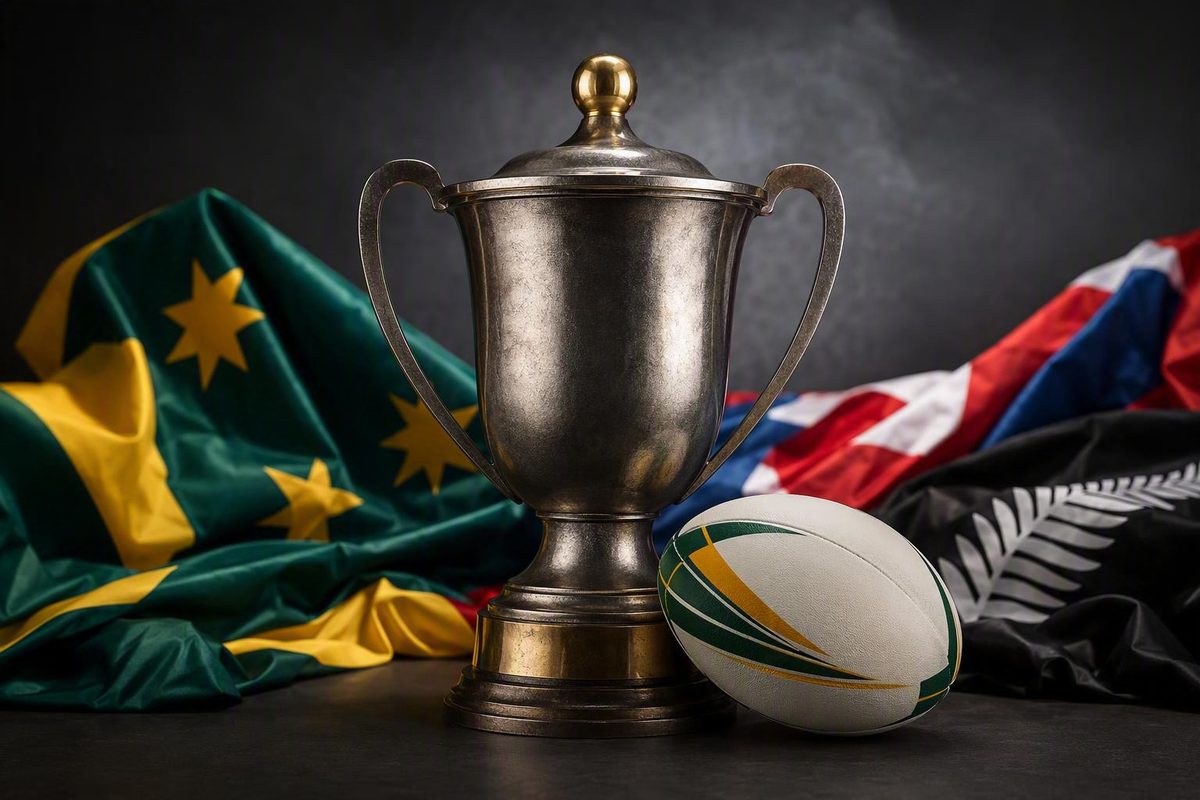
Rugby league's world cup began in 1954 — the first for either rugby code. Australia dominates the honor roll, but the full history is stranger than the trophy count.
Rugby league staged a world cup thirty-three years before rugby union got around to one. The 1954 tournament in France — four nations, a round-robin, and a final added almost as an afterthought — began international team sport’s strangest trophy history.
The honor roll, compressed
Three nations have ever won it. Great Britain took the first tournament in 1954 and added 1960 and 1972. Australia owns the trophy’s modern history almost outright — champions in 1957, 1968, 1970, 1975, 1977, 1988, 1992, 1995 aside (more below), 2000, 2013, 2017, and 2021 (played 2022) — a dozen titles and counting. New Zealand has broken through once, in 2008, beating Australia in the final in Brisbane. France, league’s continental heartland, has hosted and contended but never won; England, competing separately from Great Britain since the 1990s, has lost finals but never lifted it.
The one Australia “miss” in the modern era proves the point: in 1995, amid the Super League war that split the sport, a weakened Australia still reached the final before England’s tournament — and lost it to the full-strength Kangaroos is how most histories would have gone; instead Australia won that final too. The last time anyone else’s anthem played after a final was 2008.
Why the gaps between tournaments?
The world cup’s schedule is famously irregular — 1954, then roughly every three to five years, with a thirteen-year gap between 1977 and the 1985–88 rolling format, and another stretch to 1992. The tournament has been a knockout, a round-robin, a multi-year league, and a travelling series. League’s small international footprint — the game’s professional heartlands are Australia’s east coast, northern England, and New Zealand — meant the tournament repeatedly reinvented itself to stay viable.
The scores behind the history
League’s scoring system (tries worth four points, goals two, field goals one — a structure settled in 1983 when tries went from three to four) produces higher, more granular scores than union’s. World cup finals reflect it: Australia’s 2013 final win was 34-2; the 2008 upset ran 34-20. Blowouts against emerging nations have produced the tournament’s least flattering records — wins by 100+ points appear in qualifying history — which is the honest cost of a sport still spreading its international game.
The 1954 tournament’s four founding nations are still, essentially, the sport’s contenders. That continuity is either the record book’s charm or its indictment — the data, as always, declines to editorialize.