
How rugby league became an international game
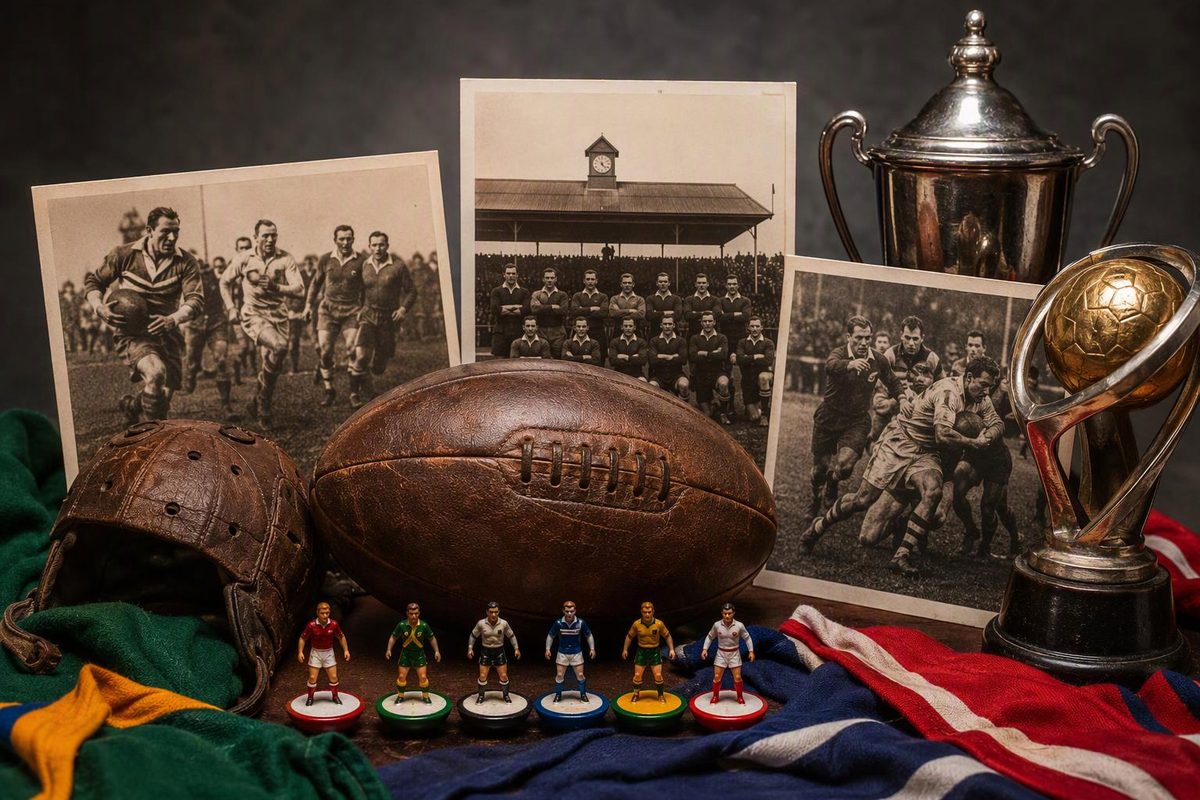
Trace rugby league’s 1895 origins, the move to thirteen players, early international tours and World Cups—and learn how to read older records.
Rugby league began in northern England in 1895, following a dispute over compensating players for time away from work. The thirteen-a-side game developed afterwards; international tours and the World Cup gave it a record book of its own. This history follows rugby league, rather than the separate rugby union code.
1895: the split was about payment, not thirteen players
On 29 August 1895, clubs meeting at the George Hotel in Huddersfield broke away from the Rugby Football Union to establish the Northern Rugby Football Union, usually shortened to Northern Union. The central dispute concerned broken-time payments: compensation for wages lost while playing rugby. The RFU’s enforcement of amateurism prevented those payments, placing a particular burden on working players. The Rugby Football League archive’s historical account identifies this as the main division behind the breakaway and records the governing body’s adoption of the name Rugby Football League in 1922.
1906: the recognisable league game takes shape
The new organisation initially retained rugby union’s playing laws. League was therefore not created overnight as the modern thirteen-a-side sport.
In 1906, the Northern Union reduced teams from fifteen players to thirteen and introduced an early form of the play-the-ball. Those changes helped establish league’s distinctive structure: fewer forwards and a restart after a tackle, rather than union’s contest for possession through rucks and mauls. Te Ara’s history of rugby league records the initial retention of union laws and places both changes in 1906.
That sequence matters when describing the sport’s age: 1895 marks the organisational split; 1906 marks the adoption of thirteen-a-side teams. They answer different historical questions.
1904–1910: internationals and tours
The first rugby league international actually preceded the thirteen-a-side change. On 5 April 1904, England played Other Nationalities at Central Park, Wigan. The opposition consisted largely of Welsh players, with Scots also represented. It was an experimental twelve-a-side match—not a modern thirteen-a-side Test between two national teams. Historian Tony Collins explains the fixture and its unusual format.
The next major expansion came through New Zealand’s 1907–08 All Golds tour, organised by Albert Henry Baskerville. The tourists played rugby union rules during their early stops before adopting Northern Union rules in Britain, where they won the Test series 2–1. They also won a three-Test series in Australia on their return journey. Te Ara records the tour’s route and results.
Australia’s first rugby league premiership competition, organised by the New South Wales league, began on 20 April 1908, and the first Kangaroos toured Britain later that year. The National Museum of Australia documents these beginnings.
A British touring side visited Australia and New Zealand in 1910. These journeys established enduring international connections, although touring schedules also included club and other representative opposition—not just Tests. Collins’s account distinguishes the early tours’ Tests from representative fixtures.
1954 onwards: the World Cup broadens the record
French official Paul Barrière championed the World Cup idea, which became reality in France in 1954. Great Britain defeated France in Paris to become the first World Cup winners in either rugby code, according to International Rugby League’s tournament history.
Australia, France, Great Britain and New Zealand contested that first tournament. Each played the other three before the top two met again in the final, which Great Britain won 16–12 on 13 November. The 1954 results record shows the complete seven-match competition.
The women’s World Cup began in 2000, creating a separate international title history. New Zealand won that inaugural tournament; Australia’s first women’s title followed in 2013. See the IRL history and NRL women’s winners table.
New Zealand’s first men’s World Cup triumph came in 2008, beating Australia 34–20, as recorded by Te Ara. Samoa later appeared against Australia in the final played in 2022, which Australia won 30–10. The NRL match record dates that final to 19 November 2022; it belonged to the postponed tournament branded the 2021 Rugby League World Cup. For the tournament-by-tournament account, see our full World Cup winners history.
Reading older results: preserve the era
Historical scores need their original scoring values. In the 1954 final, Great Britain scored four tries and two goals for 16 points. The match scoresheet illustrates the difference:
| Great Britain’s scoring actions | At the 1954 values | At the values in the 2024 international laws |
|---|---|---|
| Four tries | 12 | 16 |
| Two goals | 4 | 4 |
| Total | 16 | 20 |
The 2024 international laws award four points for a try and two for a conversion or penalty goal. The modern-value column is only an arithmetic illustration; it does not change the official result.
Team labels need similar care. Older British sides appeared under names including Northern Union, England and Great Britain, while some representative internationals did not carry full Test status. Collins traces those distinctions. Before comparing records, specify the team being counted, whether the matches are Tests or all tour appearances, and the tournament format—not merely the final score.